
Triply Stainless Steel — Is It Really Worth It? An Honest Guide for Indian Kitchens
- April 15, 2026
- By SF & Sons
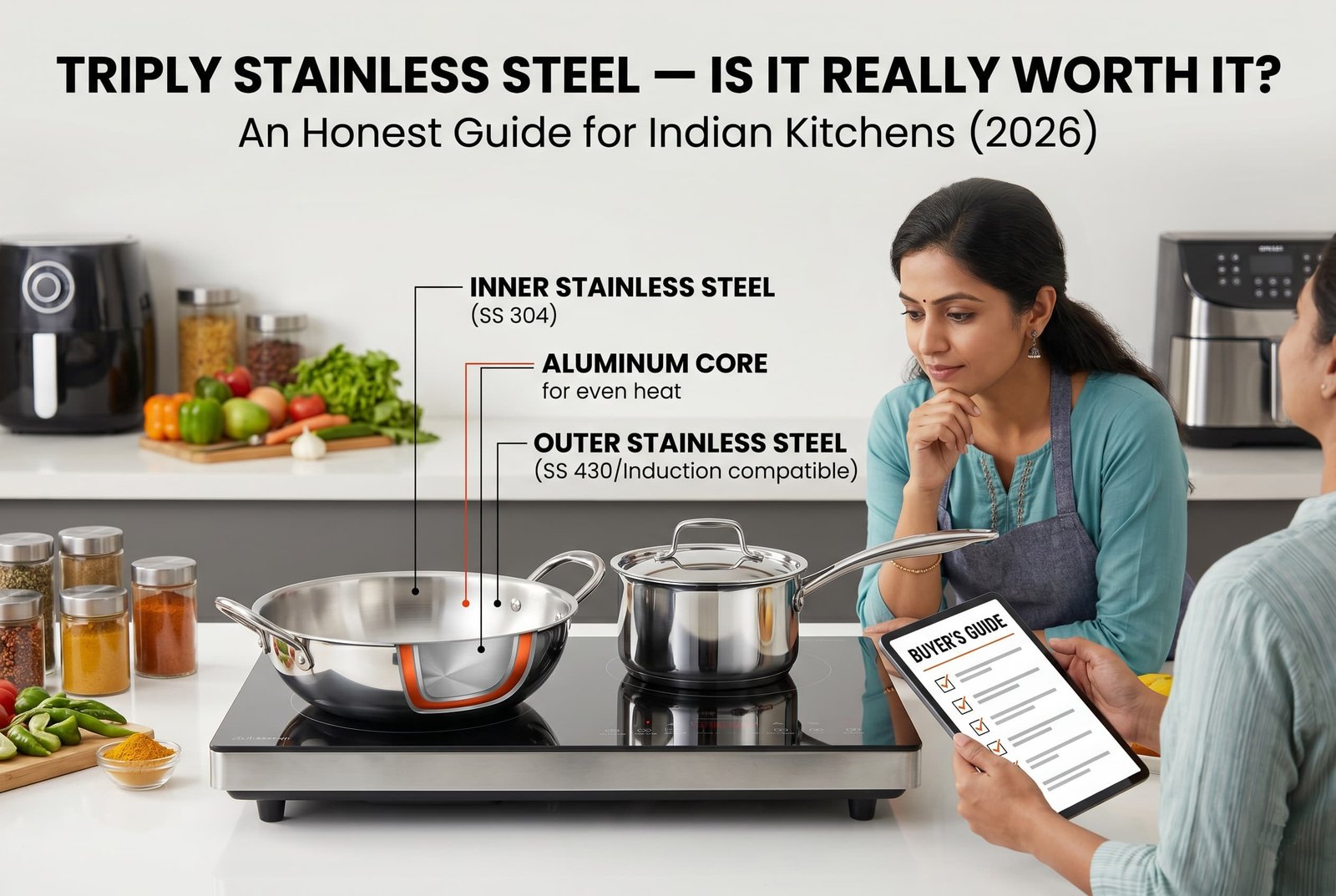
If you have been scrolling through kitchen product pages lately, you have probably seen “triply stainless steel” everywhere. It sounds like a premium upgrade — but is it actually better than what your family has been using for decades? And more importantly, is it worth the higher price tag? This guide gives you a straight, no-fluff answer.
At SF & Sons in Begum Bazar, Hyderabad, one of the most common questions we get from customers walking into our store is: “Bhaiya, yeh triply waala kadai kya hota hai? Aur kya sach mein fark padta hai?” (What is this triply kadai? Does it really make a difference?)
The short answer — yes, it does make a difference. But whether that difference is worth your money depends on how you cook, what you cook, and what you value most in your kitchen. Let us break it all down clearly.
What Exactly Is Triply Stainless Steel?
Triply (also written as tri-ply or 3-ply) simply means three layers of metal bonded permanently together to form a single piece of cookware. Think of it like a sandwich — strong on the outside, highly functional in the middle.

Each layer does a specific job. The aluminium core is what makes triply genuinely different from regular steel — aluminium conducts heat roughly five times better than stainless steel. But since aluminium reacts with acidic foods like tomatoes, tamarind, and lemon (common in South Indian and Hyderabadi cooking), the stainless steel layers on both sides keep the aluminium completely enclosed, away from your food.
The result is cookware that heats evenly across the base and up the sides, without any chemical concern.
The Real Problem with Regular Stainless Steel
Most Indian kitchens have grown up with standard stainless steel vessels — the classic patila, kadai, and bhagona. They are sturdy, rust-proof, and familiar. But single-layer steel has one persistent weakness: uneven heat distribution.
Heat concentrates right where the flame touches the base. The edges and sides stay cooler. This creates what cooks call “hot spots” — patches on the cooking surface that get far hotter than the rest. The results in an Indian kitchen:
- Spices burn quickly during tadka if you turn away for even a few seconds
- Dal and gravies scorch at the bottom while the top remains undercooked
- Food sticks at the center base even with generous oil
- You constantly stir and adjust the flame to compensate
Triply construction solves this at the design level — not with a coating, not with Teflon, but with the physics of how the three layers conduct heat together.
5 Genuine Benefits of Triply Cookware for Indian Kitchens
1. Even heating from base to sides
Heat travels through the aluminium core and spreads across the entire surface — base and walls together. For Indian cooking, this is significant. A dal simmering in a triply vessel stays at a consistent temperature throughout, not just at the bottom where the flame hits.
2. No chemical coating — ever
Non-stick coatings (Teflon, PTFE) are convenient but they deteriorate. Research published in recent years has found that a scratched non-stick pan can release thousands of microplastic particles. Triply steel has no coating at all. The inner surface is surgical-grade stainless steel. Nothing leaches into your food, at any temperature.
3. Works on gas, induction, and electric stoves
The magnetic outer steel layer makes triply fully induction-compatible. As more Hyderabad homes shift to induction cooking, this is an important practical benefit — you buy once and it works across every cooktop.
4. Less oil needed
Because heat is consistent and no single spot overheats, food is less likely to stick. Most home cooks using triply for the first time are surprised by how little oil their cooking requires once they adjust their technique slightly.
5. Faster cooking, lower gas consumption
Aluminium heats rapidly. Once a triply vessel reaches temperature, it holds it efficiently. You spend less time on high flame, which adds up to meaningful fuel savings over months of daily use.
Triply vs Regular Steel vs Non-Stick — Quick Comparison
| Feature | Triply Steel | Regular Steel |
|---|---|---|
| Heat Distribution | ✓ Even (all over) | ✗ Uneven (hot spots) |
| Chemical-Free Cooking | ✓ Yes | ✓ Yes |
| Induction Compatible | ✓ Yes | Depends on brand |
| Durability (Lifespan) | 15–25 years | 10–15 years |
| Safe with Acidic Food | ✓ Fully safe | ✓ Fully safe |
| Oil Requirement | Minimal | Moderate |
| Price Range (India) | ₹1,500 – ₹6,000+ | ₹300 – ₹2,000 |
| Best For | Daily serious cooking | Boiling, storage |
Where to Buy Triply Stainless Steel in Hyderabad
If you are in Hyderabad and looking for reliable, good quality kitchen items — you do not need to order blindly online. SF & Sons at Begum Bazar lets you physically examine the build, check thickness, test handle grip, and compare models side by side before buying.
We serve customers from across Hyderabad — Banjara Hills, Jubilee Hills, Miyapur, Kukatpally, LB Nagar, Secunderabad, Mehdipatnam, and beyond — who prefer buying cookware from a trusted bartan shop rather than taking a chance on an unknown online seller.
We also ship across India through sfandsons.com, with free delivery on orders above a set minimum.
SF & Sons tip: At our Begum Bazar store in Hyderabad, we stock the Hawkins Pro Triply range — one of the most trusted names for triply stainless steel in India. The Hawkins 2.5 Litre Triply Kadhai is our best-selling triply piece and is ideal for daily Indian cooking on both gas and induction. Come in and feel the weight and build quality for yourself before deciding.